Another company has finally gotten together what looks to be the right amount of money to do what I've wanted to do for quite some time. This one looks like one of the best implementations of this style system outside of some of the ones deployed in Europe. Very well-done B-cycle! Now let's just get it to come to SLC, ask for it here: http://bcycle.com/who_wants_it_more/
***Rambling post alert!*** ***with videos*** Airplanes are great for traveling long distances (long being 1,000+ miles) but for shorter distances, trains can't be beat. I know you're thinking clickety-clack
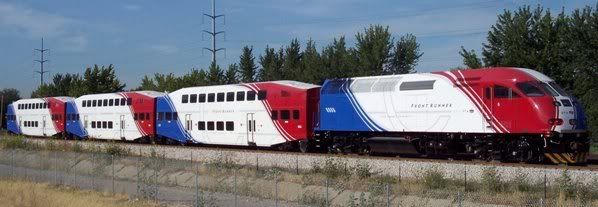
but believe it or not, as much as it has been shunned in the USA, train technology has been doing more than just "clacking along". As mentioned earlier, UTA is starting up their "Front Runner" commuter rail line from Ogden to SLC with a line from Provo to SLC to follow in the next few years.
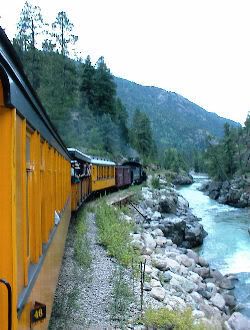
It's going to do about 80mph so that means that during heavy traffic on I-15 (which is most of the time), it'll be faster than driving! Not to mention the comfort of Wifi, work tables, and comfy chairs perfect for napping as the train cruises along the smooth steel. As cool as that is going to be, there is something better on the horizon for parts of America... high-speed rail. You may be asking yourself, (see the steam train pic above for reference) c'mon, how can trains be that fast?
This one to the left really is that fast... 357.2 mph!! That train is the current world speed record holder. Should be fast enough, eh? The technology that goes into making that train go that fast is not trivial, for example, if the wire above the train doesn't move back and forth enough, it will burn right through the pantograph! The physics behind the contact point of the wheels to the track are unbelievable to allow them to spin that fast.
I know this is a video heavy post, but they are worth it if you're interested in trains, alternative transportation, energy independence, engineering and a whole slew of other issues. Below is a proposed (and very likely at this point) high-speed rail line from the Bay Area in California to Los Angeles. Other lines are planned from L.A. to Las Vegas that would be a maglev train which would be even better!
For you locals, imagine sometime in the future being able to book a high-speed train from Salt Lake City to Las Vegas that leaves at say 9:00 am. Now swing back to what it's like to make that trip now... You have to be to the airport at least an hour early (they recommend two hours) and then the plane waits for 15 minutes (at least) on the tarmac to take off. (trip time=1.5hrs) Then you fly in cramped quarters, unless you fly JetBlue or Virgin America which don't fly to Vegas from SLC, with the heavy-set man next to you taking up more than his two purchased seats. Because of the dry aircraft air, you're pounding the Ginger Ale and H20 so you'll have to pee at least once on the trip. Those bathrooms are a joy, aren't they? Think of the movie Tommy Boy. (travel time=3hrs) You spend another 15 minutes at least at the destination airport on the tarmac (total trip time 3.25hrs). Then you wait, and wait, and wait for your bags at the luggage carousel for 30 minutes, and don't forget that you're now one bag lighter than you were when you got on the plane because your other bag is in Mexico City. (trip time=3.75 hrs) So after roughly 4 hours, you're in Vegas! Which is good, because driving would have taken you 5 hours to get there (depending on how you drive) so you got there an hour earlier.
Now imagine the first scenario where you book your 9:00am high speed train from SLC to Las Vegas. You arrive at the train station about 15 minutes before the train is set to leave. You take your bags to the train and you watch the conductor load them on the same car you're traveling on after which he gives you a hand as you board the train. You get settled in a very roomy seat with huge windows, foot rests, and various recline positions. You can also get a work table seat if you'd like. All the room you need to stretch out. The train slowly pulls out of the station and gently accelerates up to above 200 mph almost without you even noticing. You arrive in Las Vegas rested, having used the spacious, nearly full size restroom on your car and after having a drink from the cafe car. As the train pulls into the Las Vegas station, less than 2.5 hours have passed. The train has saved you more than an hour of travel time and has also saved you more headache than you can imagine! All the time you have used much less energy to travel the same distance and with the new trains, they will either run on electric powered rails or be maglev powered. If that energy comes from a clean, domestic source, you're better off still! My opinion is that with the $1.2+ Trillion we have spent in Iraq, (somebody's got to pay that someday BTW) we could have built a large high-speed rail infrastructure which would help to get us off of foreign oil and increase national security and still have enough left over to completely double cancer research in the US, treat every American with heart disease and diabetes that goes without care today, and implement newer, energy efficient cars. That's a good chunk 'o change.
***EDIT*** I just came across this article talking about a train from Madrid to Barcelona which happens to be the same distance as Salt Lake City to Las Vegas that I referenced above. It's challenging planes at that distance, and I know I would surely take the train over the plane for a 410 mile trip!
First off, I'm not going to do this film justice in any way, shape, or form without holding your hand and taking you down to the theater to watch it full-length. That might be a bit difficult to do, so I'll do my best to try to get you interested in seeing it yourself.
First off, the trailer.
Gina and I really wanted to see this movie, and thanks to Tom getting us tickets at the SFF we were able to go!
"A Crude Awakening" and An Inconvenient Truth" were good and decent, respectively; however, on a scale with the three films together, "Fields of Fuel" is way ahead of the curve. While the first two show us all how screwed up we will be if we don't do anything, they don't offer very many glimpses of hope and they make it seem like there is nothing the individual person can do to help the problem.
Fields of Fuel, on the other hand, offers a very humanizing view of the current energy situation that the US faces. It does not dwell on well-documented but not-quite-proven theories (like the Theory of Global Climate Change and that crazy Theory of Gravity, for instance) but instead focuses on tangible evidence that the way we use energy here in the US is not sustainable and has backed us into a corner that requires immediate change. While some other countries have done this too, we don't live there, we live here and should worry about it here. Josh Tickell then continues on to give the audience various ways in which the individual can make a difference. Below is a list of 10 things he suggests. Not everybody can do all of these right away, but everybody can do at least one of these.
1) Buy a biodiesel, hybrid, electric, or ethanol car 2) Change your fuel to biodiesel, ethanol, or electricity 3) Switch your local school buses to biodiesel 4) Get your gas station to sell biofuel 5) Start a biofuel purchasing co-op 6) Get green energy education into your local schools 7) Use public transportation, bike, or walk 8) Vote for leaders committed to green energy 9) Buy electricity from solar and wind companies 10) Learn more: read Biodiesel America
In the film, Josh gives a very holistic approach to the use of biofuels. He realizes that they are not the ultimate answer, but they are what we can do NOW to get the ball rolling in the right direction. He tells the audience very matter-of-factly that the only way to fix the energy problems in the world is to move towards a diversified energy structure where the energies being used cannot be monopolized by governments or by any one large corporation.
PS, did I mention it received the Documentary Audience Choice Award at Sundance?!
I haven't blogged for a bit, so today turns out to be a good day to blog. We had a great time this weekend with our friends, Steve, Liz, and Nash (and Lexi too of course), that finally joined us up in Salt Lake. Cornia even showed up at their house! He's got a great reggae band, "Carlos Cornia" that I actually have yet to see in person, but want to really bad. We went to eat at Settebello, mmmm, that's all that needs to be said about that :-)
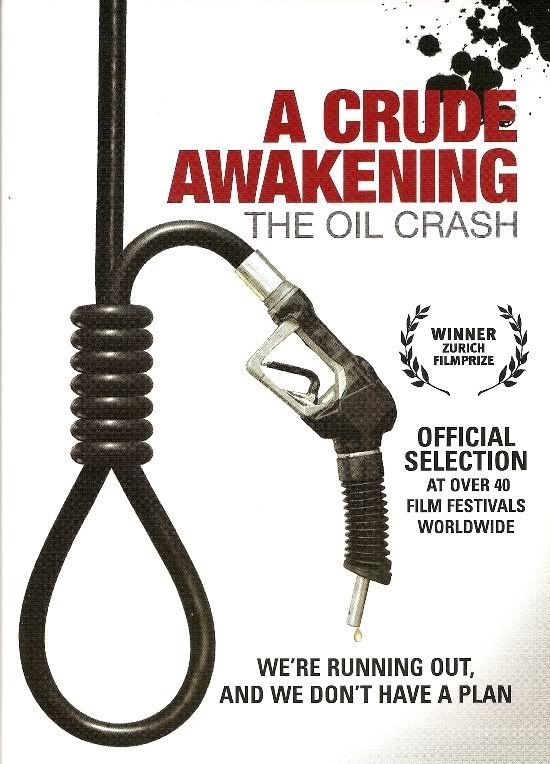
But the main thing that spurred me to post was the movie that Gina and I just got done watching, A Crude Awakening. My favorite part was hearing about Hubbert's Peak because I have learned about it in school already and could relate to it. I highly recommend the movie if you have not seen it
The movie is very well researched and follows along very well with what scientists like Hubbert have been telling us since the 60's and 70's. So far, they've been very close to perfect with their estimations about oil reserves and our obscene exploitation of those reserves. For those of you that remember the 70's gas crunch, that was only a drop in production of crude oil by about 5%. Royal Dutch/Shell announced in 2004 that it really knew of 20 percent fewer oil reserves than they had been reporting up to that point. At the time, 20 percent of just their reserves equated to 3.9 billion barrels of oil valued at $136 Billion at that time. Today that same amount of oil equates to nearly $254 billion at current ~$65/barrel prices. Evidence that our oil reserves are limited is all around us. Many countries are now importing more oil than they are producing and it's not far off for the U.S. either. At the rate we're using it, even all of our "untapped" reserves would not sustain us for very long in a crisis. It's an interesting movie and shows how dependent we are on oil. A change is needed, and there is no silver bullet. No matter the mechanisms that you use (even my beloved biodiesel) we will all have to use less of it and promote sustainability and conservation. Go out and rent this movie, if nothing else, to simply be aware of what is to come in our future.
I've heard many excuses for not riding mass transit, but the one I hear the most is that there is not a convenient bus route that matches where the person wants to go. I thought this was the case for me personally for a long time until I discovered deadheading buses. Imagine the typical US city with a downtown in the center (generally) surrounded by suburbs. Buses run in the morning carrying the throng of people from the suburbs to the city center. Because there are fewer people going away from the city center in the morning, they run empty (what is called a "dead head run") from the city center back to the suburbs to then pick up another load of passengers. Any bus scheduler will tell you that it is almost impossible to avoid some dead head runs, but the good news is that most bus companies will still let riders travel on the dead heading buses. In my example, I travel from near the city center against the majority of traffic. I never thought there was a fast bus that traveled in that direction so I would either drive or wake up obscenely early to ride my bike or take the combination of TRAX and the 811.
If anyone is familiar with the 811, you know what it's like. It's a 93 series bus generally, which means that it tops out at 55 mph on the freeway and wasn't even built for the freeway to begin with. It's generally packed with people (most of which wouldn't be riding it if they knew of other options) and stops every few yards as it lumbers along it's route. Not to mention that air seems to seep right through the windows as well as through the floor and doors... and roof and everywhere. This provides the opportunity to get the sauna feeling in the summer and the ice cream isle feeling in the winter. I thought the above were my only options that I could ride until I saw a dead heading bus one day completely empty. You can imagine the situation... me, standing on the 811 (because there's no where to sit) huddled next to the most pleasant people in the world and as I gaze out the window at the mountains, I see a nice commuter bus (see pic below) cruising by completely empty! So I said to myself, "Self, I REALLY need to be on that bus!" I emailed UTA that day and they informed me that I could ride those dead heading buses. The next day I caught one.
I was hooked! It was just as fast as driving because the bus makes no stops until it gets back out to the suburbs (or Orem in my case). It's a straight shot at 75 MPH from Salt Lake City to Orem and it is amazing. It affords me about 40 minutes extra studying time, reading time, or SLEEPING time. Hello, who wouldn't want to catch an extra 40 minute nap to and from work? So I ride a dead heading bus (there are many of them) nearly every day and going to work is so much more enjoyable now!
If you think you can't ride the bus because there is no route available to you, it may be worth contacting your local transit authority and asking them if there is a dead heading bus that may fit your schedule. I have been emailing UTA once every few months asking them to advertise the dead heading buses, so I hope they do one day. I hope they don't change the route that they run, but at least advertise them!
Most people however can ride the normal express buses (VERY fast options=Bus# 801-810) easily. In addition, many large companies will offer cheap bus passes to their employees which makes the commute drastically cheaper than driving and just as fast with nearly front door service in downtown SLC. Even if your company doesn't give you a cheap pass, a monthly express bus pass (including TRAX and all other buses) is $107. With just a little arithmetic and gas at $3/gallon, that means you would only need to make about 11 trips from Orem to SLC and back to break even on a monthly pass (assuming you get 25mpg). Many people make more than 11 trips to SLC and back in a month, so it's quite cheap. Not to mention less wear and tear on the car and the ability to arrive at work much more relaxed.
oh yeah, and if you're looking for pics of our Bald Mountain hike (cause I know you are...), they can be found at The Bradlee Duncans
After way too long, Salt Lake City and the adjoining areas of the Wasatch Front are finally getting a commuter rail line. When all is said and done, it will run from Davis County (up North) to Provo (and maybe even further South). After Salt Lake City killed the two amazing train stations that it had to it's name, it was time for another one to take the place of the other two (Rio Grande and Union Pacific). The new inter-modal hub is just the ticket and is pretty cool although if somebody was thinking straight they would have converted one of the existing train stations in all their glory and turned it into the inter-modal hub. Oh well, I can always dream that someone might think in the long-term, right?
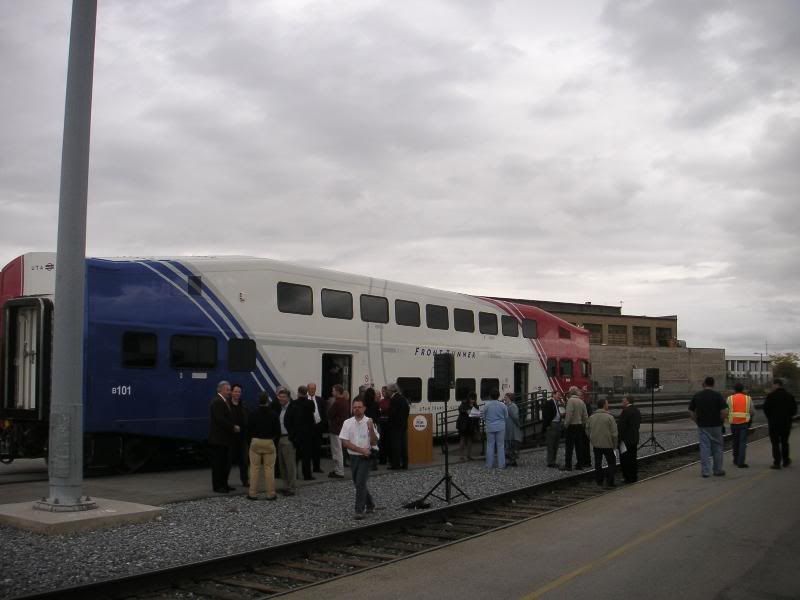
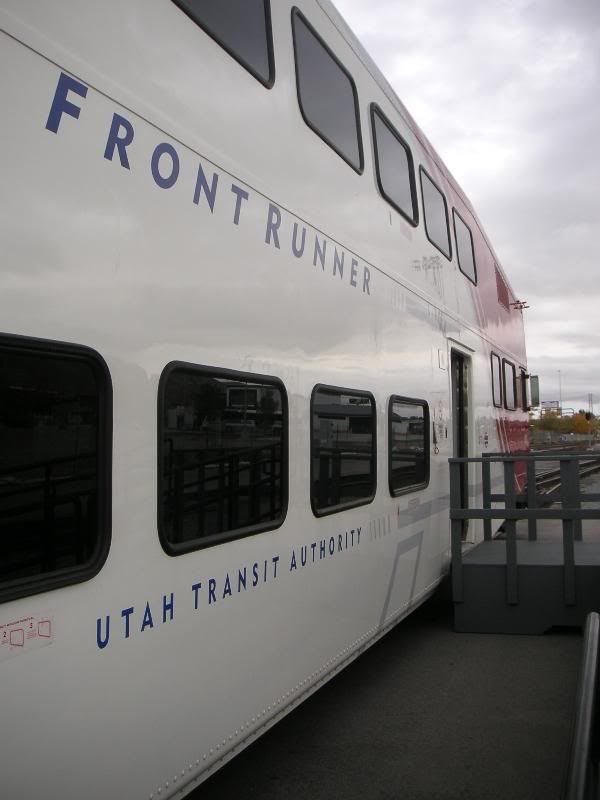
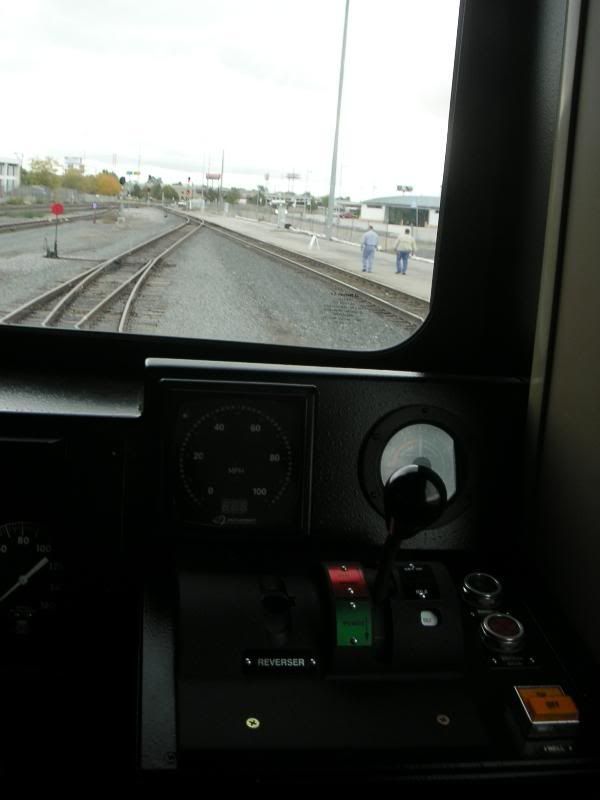
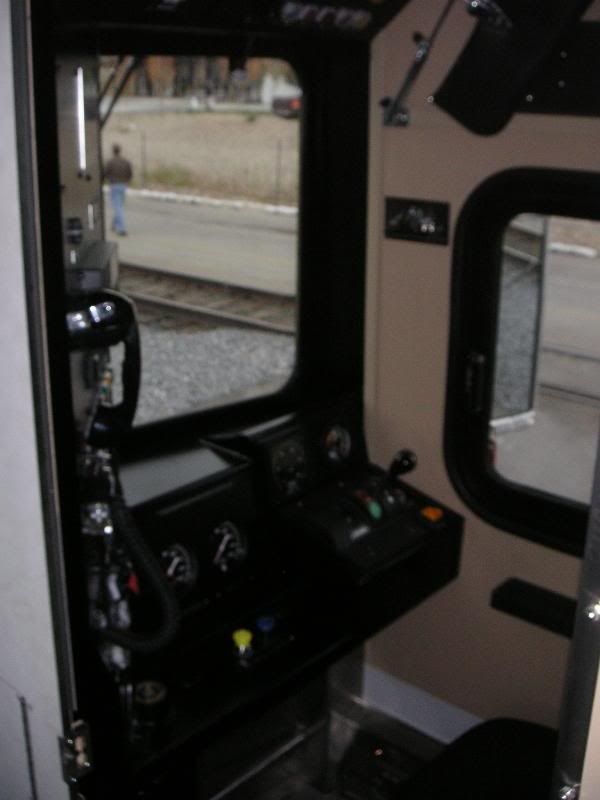
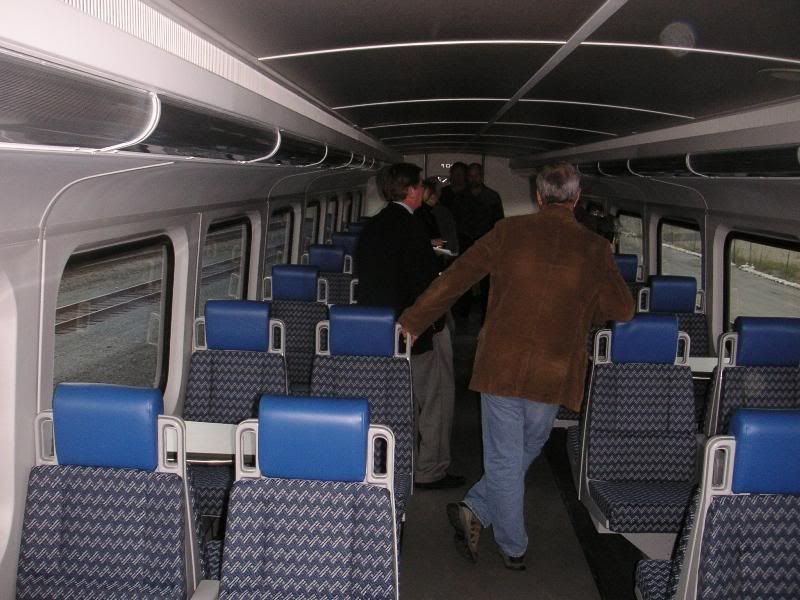
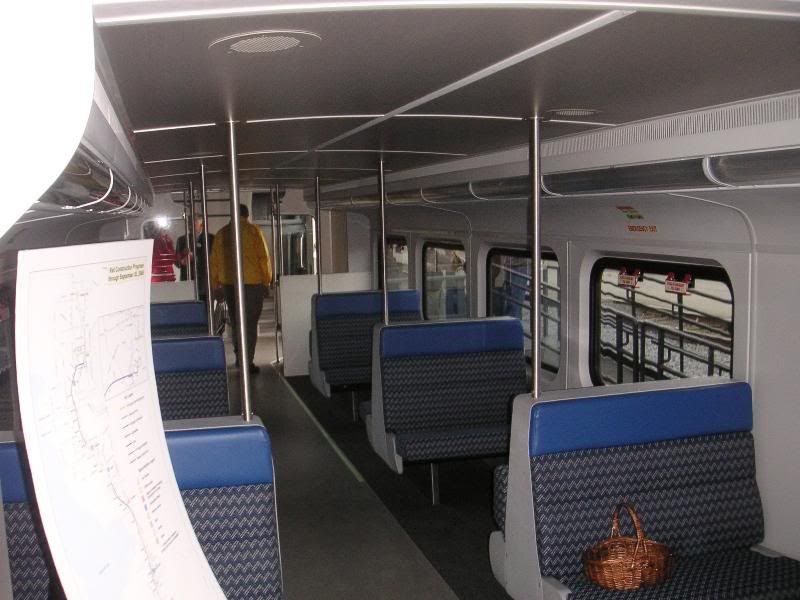
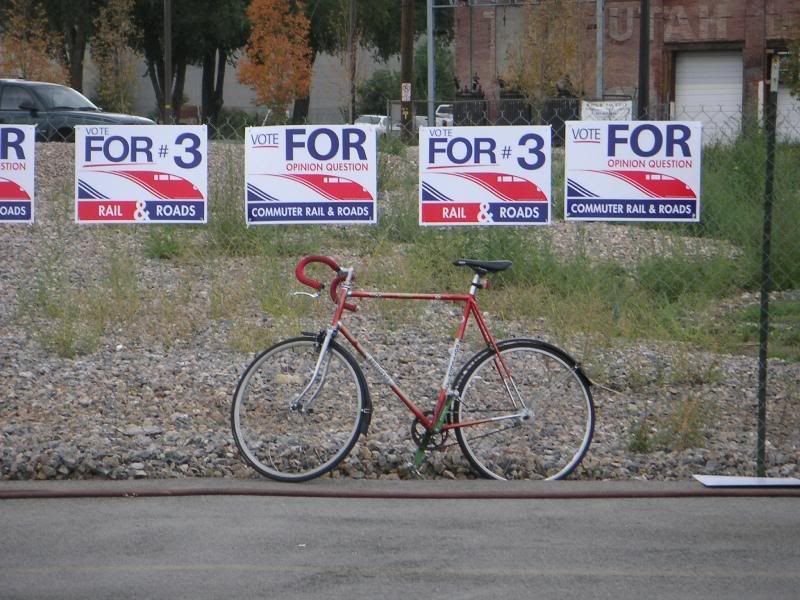
Anyway, I was riding out to eat lunch with Gina out at Franklin-Covey and as I was riding over the 400 railway overpass, I looked to my right towards the inter-modal hub and saw a gathering of people around a new Frontrunner train car! They weren't supposed to have those cars for another year! I quickly turned around (dodging traffic of course) and headed over to "investimagate" with the trusty point and shoot camera in tow. Once I got there I saw that it was a small press conference for the Proposition #3 "Rails and Roads." It was exciting to see and I got to go inside and take a look around the two story rail car. It was quite comfortable and will even be equipped with Wi-Fi capability! It's planned that it will travel at about 85 MPH, so that will help lure people to it because it will be faster than driving. The section from Davis County should be done sometime next year from what I hear with the SLC to Provo section being completed by 2010 or so. Proposition #3 will help speed this along.
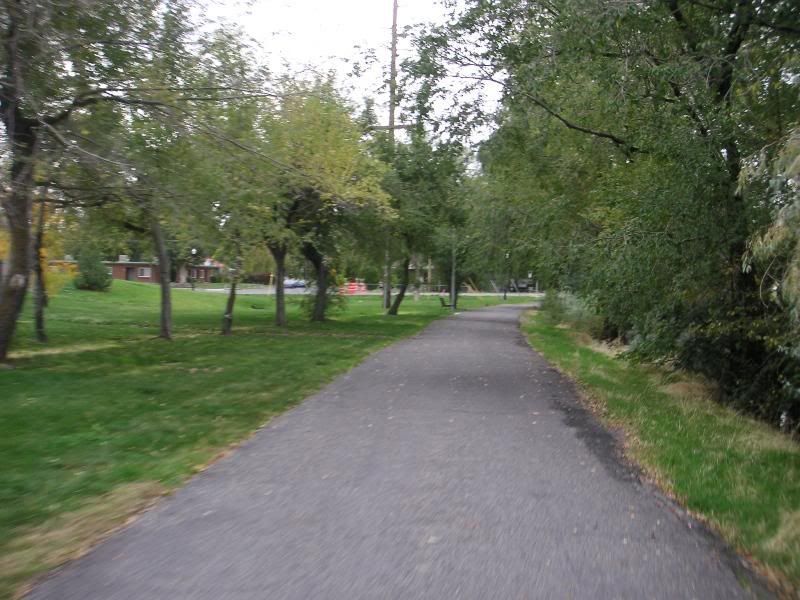
Finally, I gotta throw in a couple of pics of the bike and the ride.
Today when I was riding to Sandy to pick up my car and finish the commute to work it was a beautiful morning and as I was riding along watching the gorgeous sunrise I thought how great bicycle commuting is. I saw quite a few other bicycle commuters making the trek into work, school, etc. and as each passed, we exchanged friendly waves of understanding and comraderie. It was a nice feeling. Yesterday when I was sitting waiting for the train at the TRAX station I saw quite a few people cruising around on bikes in Downtown. This may seem like a normal thing in other cities, but Salt Lake still needs to grow up and seeing a handful of cyclists in a 10 minute time span is pretty good. It's nice to see more now than I used to.
Most trips that people make are under a mile or two long which means that at just 14mph you could travel 2 miles in just 8.5 minutes and you get to ride straight to the front at traffic lights. Now think about how long it takes you to pull your car out of the garage, drive through traffic (sometimes the worst part), and then you still have to find a parking space. While the parking space issue might be quickly resolved just outside the city, it can get much more difficult (not to mention expensive) in and around Downtown. The bicycle is the perfect solution for most of these short trips. If you haven't started using a bike for transportation, you should try it, you just might remember those early days of freedom that came from learning how to ride.