Showing posts with label oil. Show all posts

Tuesday, September 09, 2008

To drill or not to drill, you decide.

Will drilling in ANWR and the outer continental shelf help our energy situation? You decide, based on this chart built from the US Department of Energy's data.

(Data from the US Department of Energy)


***my opinion*** Sure we can drill, but why the heck are our partisan candidates even talking about drilling when it will have such a minimal effect on our situation? They've coerced us into believing that what they're talking about (drilling) really is a significant issue with regard to our energy independence when it is so clearly insignificant. Besides, in 10 years shouldn't we have other things going for us instead of needing to use our last few remaining drops of domestic oil? (and it really is drops on the grand scheme of things) Additionally, when the oil finally does come on line, we will still only be able to get it for the international oil price (currently over $100). At that price, it won't have any effect whatsoever on what you pay at the pump. Bottom line, that is not cheap oil, and there's not much of it. Yes, that little bit of oil would come from the US instead of abroad, but the other 99% of the oil we use would still be foreign. Shouldn't we address the 99% instead?

To put things in perspective, OPEC met yesterday and simply decided (it took them all of one day to decide) to turn down the flow on their 'spigot' by 530,000 barrels per day. So, on not much more than a whim, OPEC reduced their oil output by more than twice what the US could ever get by drilling as much as we possibly could. That is, assuming we would also have built the required infrastructure to process the additional oil that we drill. I'm not singling out either candidate here, because both of them are making such a big deal about whether to drill. They should NOT be focusing on drilling at all, it is a drop in the oil bucket, that's all. We have much bigger fish to fry. Don't you love partisan politics? It's either one extreme or the other and each candidate's flame is stoked further by his/her respective party instead of by the real issues.

"Clowns to the left of me,
jokers to the right,
here I am stuck in the middle with you."

Sunday, April 20, 2008

Friday, February 08, 2008

Miles per Dollar?

I heard a good suggestion the other day. That is to start thinking about fuel economy in economic terms, i.e. to think about it in "Miles Per Dollar" or, MPD. It's all too easy to just stick in that credit card on each fill-up and just kind of forget about how much you're actually getting for that money. Some people just pour that money down the drain (or out the tailpipe for that matter) without even thinking twice about how much it's costing them. To other people, they couldn't care less how much it's costing them no matter how high the cost.
Now for some examples using $3.00/gal fuel:

A 15mpg (insert nearly any SUV here) would do roughly 5 miles per dollar.
A 22mpg Audi A4 (which I used to own and loved) would do roughly 7 miles per dollar.
A 25mpg (insert nearly any regular sedan here) - 8 miles per dollar
A 30mpg Honda Civic - 10 miles per dollar
A 45mpg Jetta TDI still only allows you 15 miles per dollar

So next time you're driving down the road in an "economical" car (e.g. Toyota Camry) doing 25mpg, just count mile posts! Every 8th mile post you pass, pull a $1 bill out of your pocket. For you locals, a normal round-trip drive from Provo to SLC (45 miles) costs over $10 in that "economical" 25mpg car! If you drive around town frequently, just try zeroing the tripmeter in your car at the beginning of the day and see where it ends up at the end of the day. You may be surprised. Let's just be glad we don't have the $6+/gallon fuel that other parts of the world have.


Remember, gas prices go up in the Spring! :-)

Sunday, January 27, 2008

Fields of Fuel


First off, I'm not going to do this film justice in any way, shape, or form without holding your hand and taking you down to the theater to watch it full-length. That might be a bit difficult to do, so I'll do my best to try to get you interested in seeing it yourself.

First off, the trailer.


Gina and I really wanted to see this movie, and thanks to Tom getting us tickets at the SFF we were able to go!

"A Crude Awakening" and An Inconvenient Truth" were good and decent, respectively; however, on a scale with the three films together, "Fields of Fuel" is way ahead of the curve. While the first two show us all how screwed up we will be if we don't do anything, they don't offer very many glimpses of hope and they make it seem like there is nothing the individual person can do to help the problem.

Fields of Fuel, on the other hand, offers a very humanizing view of the current energy situation that the US faces. It does not dwell on well-documented but not-quite-proven theories (like the Theory of Global Climate Change and that crazy Theory of Gravity, for instance) but instead focuses on tangible evidence that the way we use energy here in the US is not sustainable and has backed us into a corner that requires immediate change. While some other countries have done this too, we don't live there, we live here and should worry about it here. Josh Tickell then continues on to give the audience various ways in which the individual can make a difference. Below is a list of 10 things he suggests. Not everybody can do all of these right away, but everybody can do at least one of these.

1) Buy a biodiesel, hybrid, electric, or ethanol car
2) Change your fuel to biodiesel, ethanol, or electricity
3) Switch your local school buses to biodiesel
4) Get your gas station to sell biofuel
5) Start a biofuel purchasing co-op
6) Get green energy education into your local schools
7) Use public transportation, bike, or walk
8) Vote for leaders committed to green energy
9) Buy electricity from solar and wind companies
10) Learn more: read Biodiesel America

In the film, Josh gives a very holistic approach to the use of biofuels. He realizes that they are not the ultimate answer, but they are what we can do NOW to get the ball rolling in the right direction. He tells the audience very matter-of-factly that the only way to fix the energy problems in the world is to move towards a diversified energy structure where the energies being used cannot be monopolized by governments or by any one large corporation.

PS, did I mention it received the Documentary Audience Choice Award at Sundance?!

Friday, January 04, 2008

What do you get when...?

What do you get when you combine the following in a German Engineer's stirring pot:

Air
An alternative fuel (biodiesel, BTL, synfuel, etc)
2.2L of sparkplug-free engine displacement
Two turbochargers
A splash of urea
A 7-speed transmission
4 wheels (with all-wheel drive)
And a few other bits and bobs

????

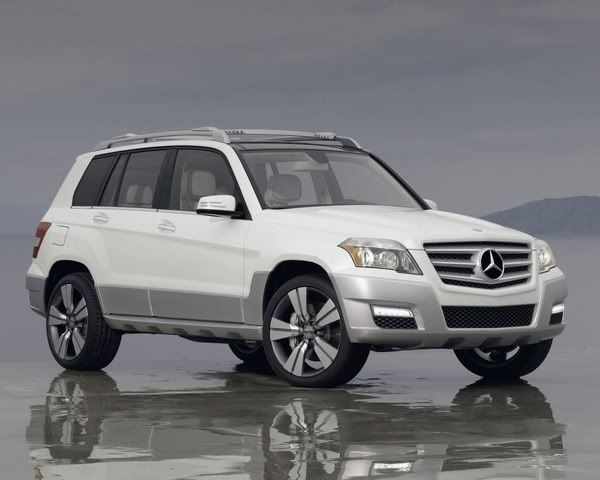
Short answer: Gina's future "mom car," the Mercedes Benz GLK.


Long answer: You get an engine that pulls like a train, has cleaner exhaust than L.A.'s air, has dual stage turbochargers (so you can still have fun), and is quieter than any diesel you've ever heard. And you get that engine with a 7-speed transmission put into a body with all-wheel drive that will tow toys, lug the kids/bikes/dog/skis/etc around, (or if you're the typical American it'll just be lugging you around alone) while already beating the fuel economy standards of the year 2020 (35mpg). The best part? It comes out this fall, so start saving your Benjamins, you'll need about 380 of them, give or take.

Thursday, August 23, 2007

Hebmüller Pre-Filter


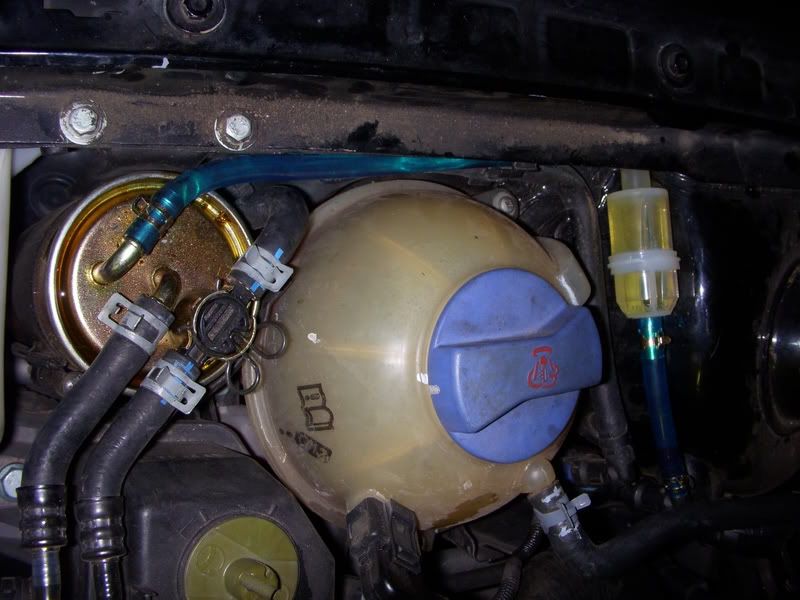
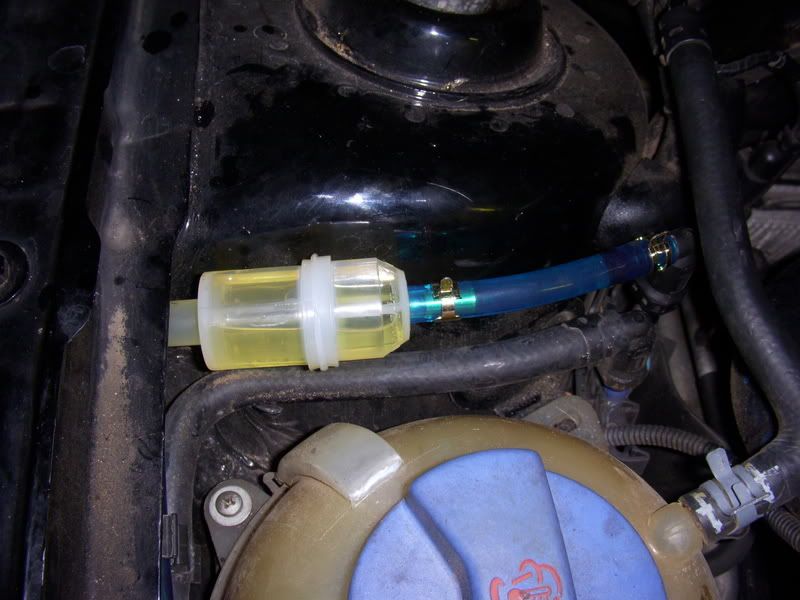
I finally got my pre-filter installed on the Jetta. It filters down to about 150 microns, which is not very small for a filter, but the larger filter medium makes sure that I don't lose any flow capacity across the filter element. However it's still small enough to catch any dino-diesel crud left over in my tank that gets cleaned out by the biodiesel before it clogs my main fuel filter. Thus, a clogged main filter is a thing of the past. :-) Had my car been running on biodiesel from the start, there would be no crud in the tank for the biodiesel to clean out so there would be no worry for a clogged main fuel filter.

It is still kind of fun to see the "bean juice" flowing freely into the engine through this clear pre-filter though. It should also help out in the winter when there *might* be a chance of the fuel gelling. This will allow me to see it easily if it happens. The air space in the top is nothing to worry about because it's a low pressure line on these pre-2003 TDI's. If it were a post-2003 engine (PD engine), the line would be pressurized by the tank pump and pump that air pocket right out.

If anyone local is interested, I have some extra filters and high-quality fuel line because I had to buy in bulk. The filter cost me $3.25 each and the hose cost me about $2.00/foot, both prices including shipping. If anybody local wants to put one on your TDI, let me know and you can buy the stuff from me for what I bought it for. Some people don't even put the new fuel hose on, but instead they just cut a section out of their original fuel line and put the filter in place, this works just fine too, but I liked the look of the blue hose, haha.

Monday, August 20, 2007

A Crude Awakening

I haven't blogged for a bit, so today turns out to be a good day to blog. We had a great time this weekend with our friends, Steve, Liz, and Nash (and Lexi too of course), that finally joined us up in Salt Lake. Cornia even showed up at their house! He's got a great reggae band, "Carlos Cornia" that I actually have yet to see in person, but want to really bad. We went to eat at Settebello, mmmm, that's all that needs to be said about that :-)

But the main thing that spurred me to post was the movie that Gina and I just got done watching, A Crude Awakening. My favorite part was hearing about Hubbert's Peak because I have learned about it in school already and could relate to it. I highly recommend the movie if you have not seen it

The movie is very well researched and follows along very well with what scientists like Hubbert have been telling us since the 60's and 70's. So far, they've been very close to perfect with their estimations about oil reserves and our obscene exploitation of those reserves. For those of you that remember the 70's gas crunch, that was only a drop in production of crude oil by about 5%. Royal Dutch/Shell announced in 2004 that it really knew of 20 percent fewer oil reserves than they had been reporting up to that point. At the time, 20 percent of just their reserves equated to 3.9 billion barrels of oil valued at $136 Billion at that time. Today that same amount of oil equates to nearly $254 billion at current ~$65/barrel prices. Evidence that our oil reserves are limited is all around us. Many countries are now importing more oil than they are producing and it's not far off for the U.S. either. At the rate we're using it, even all of our "untapped" reserves would not sustain us for very long in a crisis. It's an interesting movie and shows how dependent we are on oil. A change is needed, and there is no silver bullet. No matter the mechanisms that you use (even my beloved biodiesel) we will all have to use less of it and promote sustainability and conservation. Go out and rent this movie, if nothing else, to simply be aware of what is to come in our future.